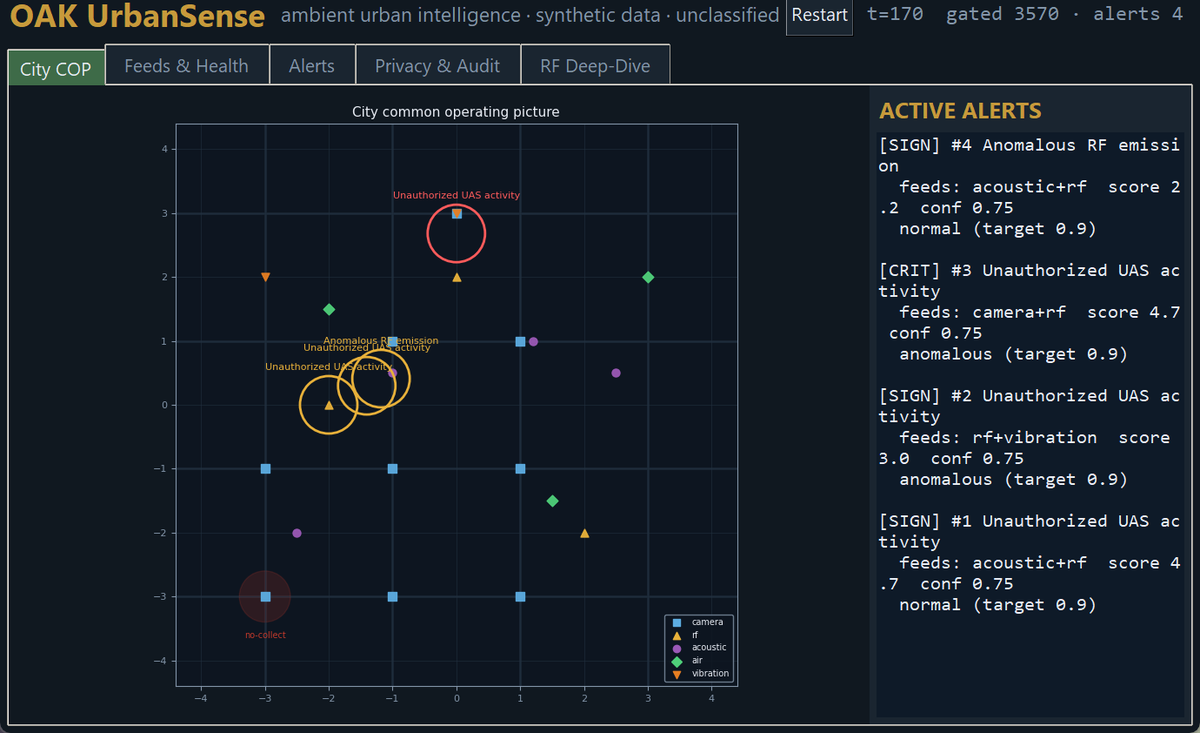
OAK UrbanSense is an AI middleware layer over a city's existing infrastructure — traffic cameras, acoustic arrays, air-quality monitors, vibration sensors and passive-RF points. A machine-readable privacy gate enforced at ingestion feeds a pattern-of-life anomaly engine that fuses indications across feed types into explainable, conformally-calibrated alerts on a city COP — unauthorized drones, rogue RF, chemical signatures, unusual crowd and vehicle patterns, in real time.
OAK UrbanSense sits on the suite's shared analytics — fusion_model multi-INT correlation, elint_model passive-RF physics and conformal calibration — behind a privacy compliance gate adapted from OAK FusionGuard's policy-enforcement engine.
Camera motion aggregates, passive RF, acoustic bands, air quality and structural vibration through one source-agnostic adapter — simulated, recorded replay or live TCP/ndjson; feeds can degrade or drop and detection carries on.
A machine-readable policy passes aggregate features only: plate reads, device identifiers and imagery references are stripped by construction; no-collect geofences and retention limits enforced; every decision on a tamper-evident hash-chained ledger.
Every sensor learns its own normal — a stadium's acoustic baseline differs from a bridge's — and new records are deviation-scored in ~63 microseconds.
Concurrent anomalies associate across feed types by gated spatial correlation: a drone is confirmed by camera + RF downlink + rotor acoustics agreeing, and confidence rises with independent corroboration.
Alerts carry a split-conformal verdict with a distribution-free coverage guarantee (target 0.90, measured 0.902) — plus contributing sensors, per-feature evidence and a plain-language rationale.
The suite's fielded ELINT chain generates and de-interleaves the urban pulse environment — airport radar, licensed emitters and the rogue transmitter separate into tracks.
UrbanSense is built and demonstrated on a synthetic city, but its analytics are validated on real public data — the credibility step from demonstrator toward relevant-environment validation.
On the DroneAudioDataset (real UAS vs. real background), a trained detector on UrbanSense's acoustic features separates real drones at ROC AUC 0.81. The decisive cue — rotor blade-pass tonality — was fed back into the product's acoustic feed.
On real hourly municipal PM2.5 data, the pattern-of-life anomaly model flags hazardous-pollution hours at AUC 1.00 / 0% false-alarm — and correctly scores a documented historic air-quality crisis (886 µg/m³) as an extreme anomaly.
The two datasets characterise the model rather than cherry-pick: strong for stable-baseline environmental / RF / vibration monitoring, and — where backgrounds are adversarially diverse — carried by the trained-detector-plus-multi-feed fusion that is UrbanSense's architecture.

OAK UrbanSense is first-principles analytics on a synthetic city — no real municipal feed is accessed. It reuses the EW SUITE's fusion, ELINT and AI-calibration libraries and adapts the FusionGuard compliance-enforcement architecture from classification policy to privacy law, carved into its own product tree.
Bring a venue, a base perimeter or an event footprint — and we'll show the ambient layer live.
Request a demo